Unlocking the Power of Nature Through Data: The Story Behind the NbS Tool Version 2 Launch
Administrator
Published 06 Nov 2025
Since its initial launch at COP28, the development team has continued to improve the NbS Tool. A key part of this process has been gathering feedback through dissemination events and user engagement. Version 2 of the NbS Tool reflects this iterative development. It brings enhanced features, expanded data coverage, and improved usability based on input from field practitioners and partners. With these improvements, there is a growing need to disseminate the tool more widely to frontline organizations, researchers, and other stakeholders across Southeast Asia to ensure it can be effectively used to support locally driven, data-informed solutions.
Nature offers countless solutions to the challenges humanity faces. Forests absorb carbon, mangroves protect coastlines, and wetlands nurture biodiversity while supporting livelihoods. Yet, the path to harnessing these benefits is rarely straightforward. Often, the data that could guide these efforts is scattered, inconsistent, or difficult to interpret.
For local organizations working on nature-based projects, understanding which areas hold the greatest potential, how to measure impact, or how to communicate results in credible ways can be daunting. What if there were a way to bring all that data together in one accessible platform, one that could turn complexity into clarity and empower communities to design stronger, data-driven nature-based solutions?
This is what the Southeast Asia Climate and Nature-based Solutions (SCeNe) Coalition set out to do through the Nature-based Solutions (NbS) Tool. Developed by the SCeNe Coalition with support from Google.org and QAI, the NbS Tool is an online platform designed to help local organizations develop high-quality projects by quantifying their benefits for people, climate, and nature.
Since its initial launch at COP28, the development team has continued to improve the NbS Tool. A key part of this process has been gathering feedback through dissemination events and user engagement. Version 2 of the NbS Tool reflects this iterative development. It brings enhanced features, expanded data coverage, and improved usability based on input from field practitioners and partners. With these improvements, there is a growing need to disseminate the tool more widely to frontline organizations, researchers, and other stakeholders across Southeast Asia to ensure it can be effectively used to support locally driven, data-informed solutions.
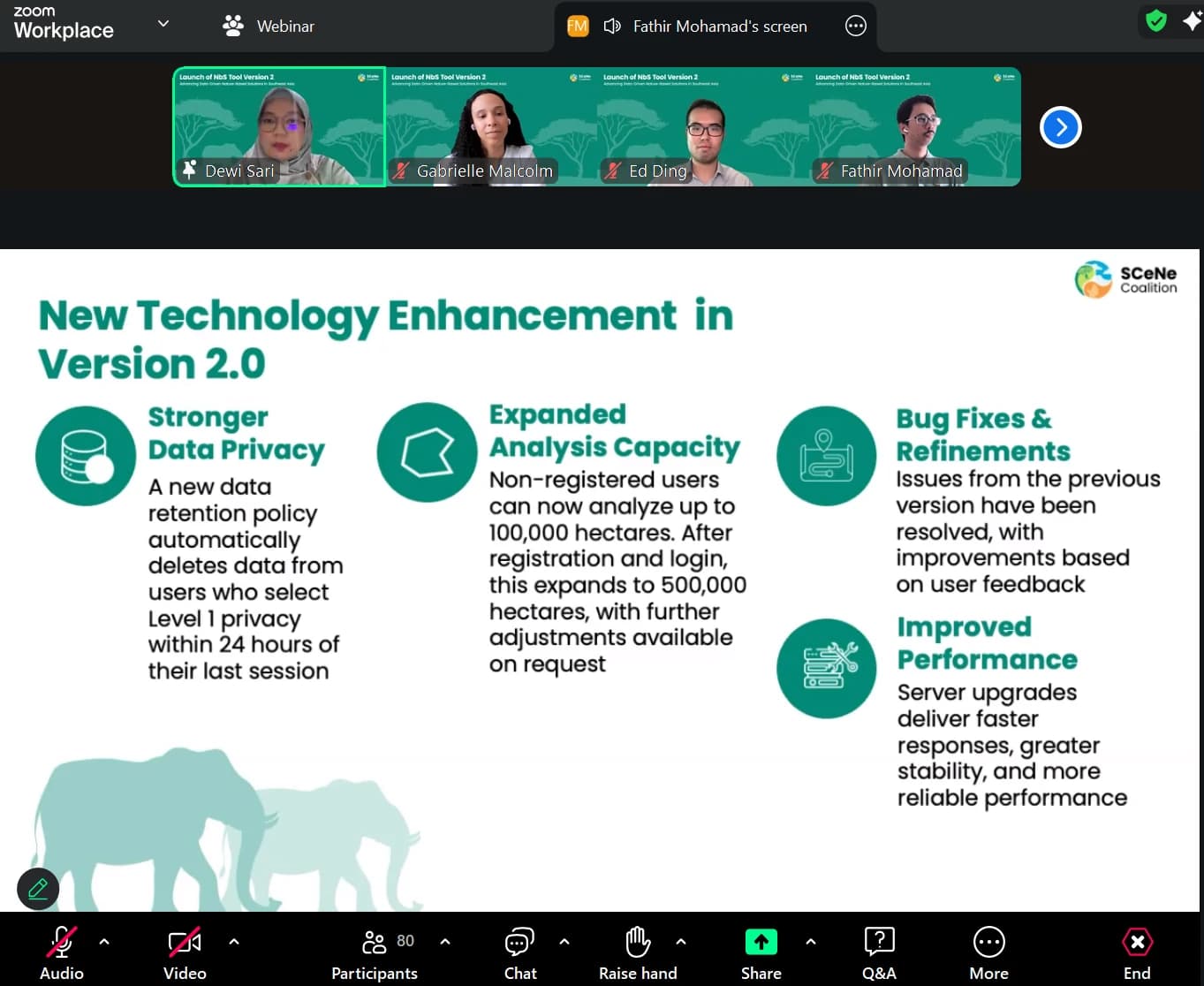
Last September, the SCeNe Coalition held a two-part online webinar series titled NbS Tool Version 2 Launch: Advancing Data-Driven Nature-Based Solutions in Southeast Asia. The first webinar introduced the NbS Tool and its latest features through an overview and walkthrough session led by Dewi Sari, NbS Tool Workstream Lead at SCeNe Coalition and WRI Indonesia’s Senior Manager for NbS. She shared several key updates, including new and more detailed geospatial data layers such as frequency of land fires, global peatland drainage, and ecosystem services. Existing layers were also updated, including drivers of deforestation and the historical data for future deforestation risk. These additions aim to enhance the quality of insights users can draw from the tool and make it easier for practitioners to apply the data to real-world projects.
Dewi Sari sharing the updates in NbS Tool Version 2.
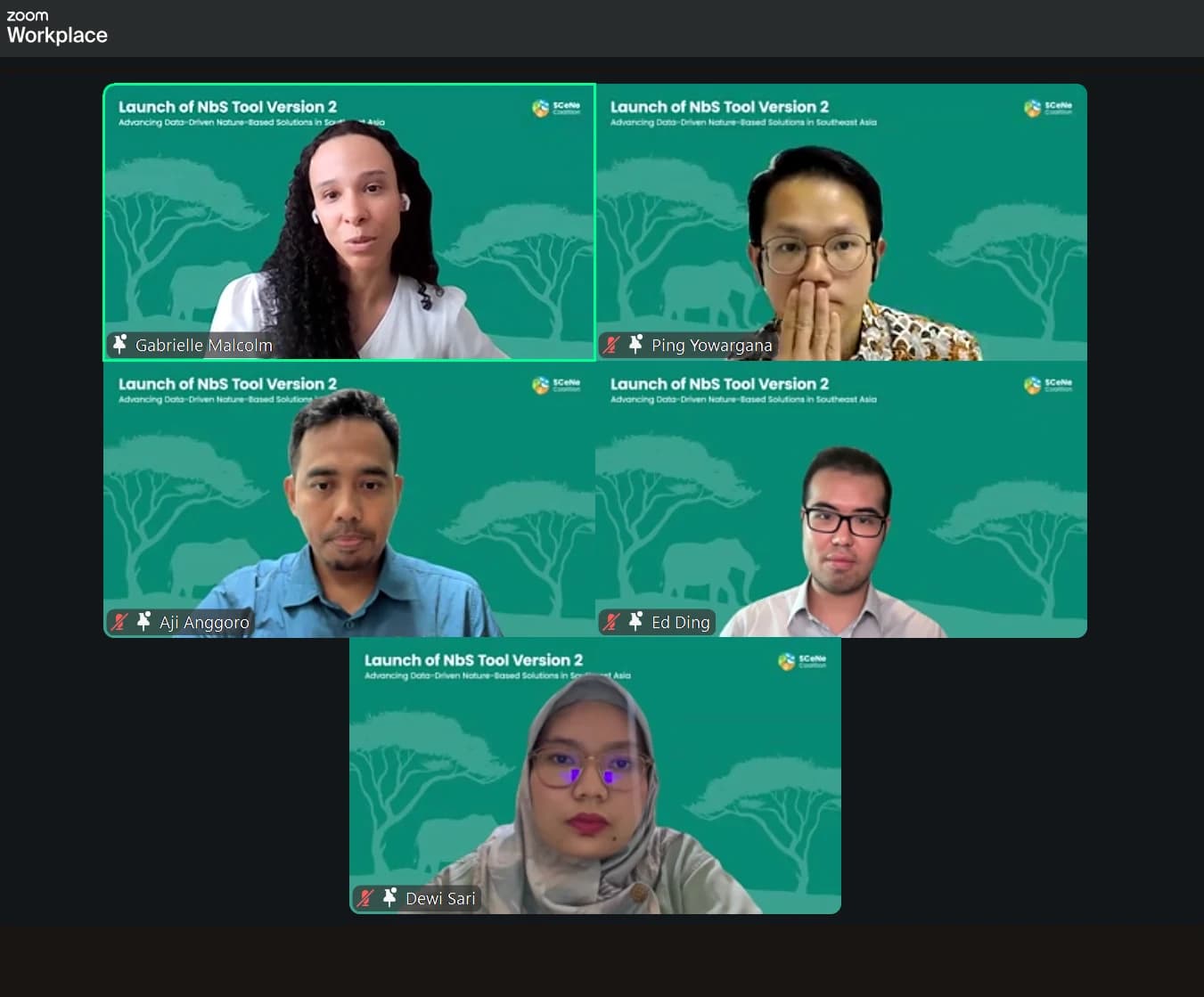
The session continued with a panel discussion titled Why Data Transparency Matters in Southeast Asia, which brought together experts to discuss the importance of open data and how the NbS Tool can support environmental protection and indigenous communities. The panel featured Ping Yowargana from IIASA, Ed Ding from Vana, and Aji Anggoro from YKAN.
Ping Yowargana discussed the importance of data integrity. “The importance of data integrity comes from understanding that NbS is unique in a way that it is really close to people and stakeholders who have different perspectives and objectives during the intervention, even in similar landscapes,” he explained. Reliable and transparent data helps bridge these different perspectives and ensures that interventions are grounded in shared understanding.
Ed Ding continued the discussion by emphasizing how establishing credible baselines is fundamental for any NbS project. Baselines are often seen as the foundation for credibility and accountability in project design. What makes a baseline credible? According to Ed, "First, it needs to be conservative, not overstating impacts. Second, it must be independently verified by a third party. And third, it should be transparent, scientifically sound, and based on peer-reviewed literature, much like what the NbS Tool does.”
The conversation then shifted toward the importance of coastal ecosystems, which also play a vital role in nature-based solutions. Blue carbon projects, for instance, hold enormous potential to mitigate climate change while supporting coastal communities.
Aji Anggoro emphasized that closing coastal data gaps is crucial to advancing these initiatives. “Completeness of data is key to achieving the highest scientific credibility. When we have a full understanding of data, all stakeholders will be more interested in developing the project,” he said. He further explained that robust, comprehensive data not only strengthens scientific integrity but also builds investor confidence. “When the data is complete, the project becomes more financially feasible because it brings confidence to the market that we are doing what we intend and will deliver the expected impact.”
All the panelist for the session.
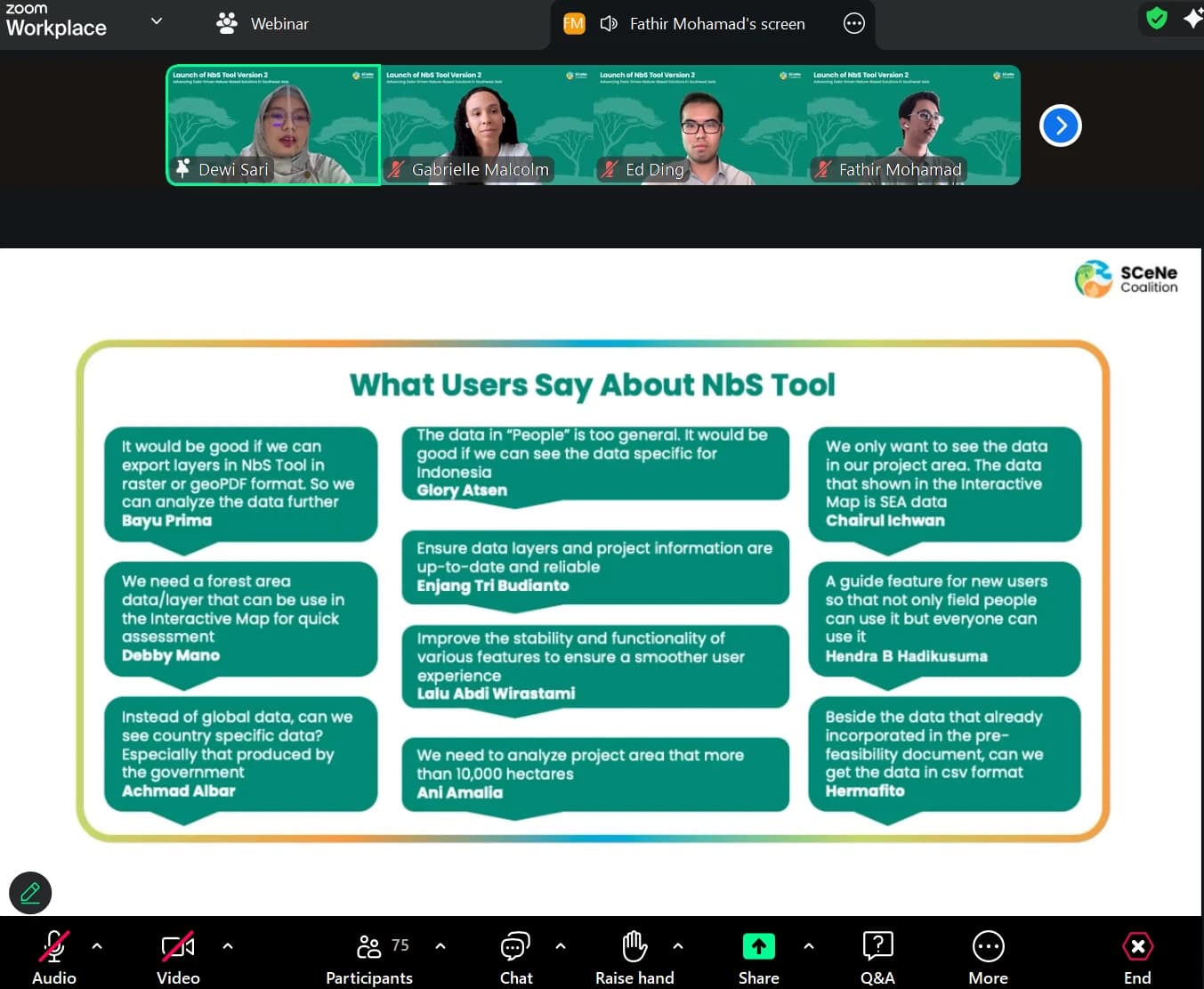
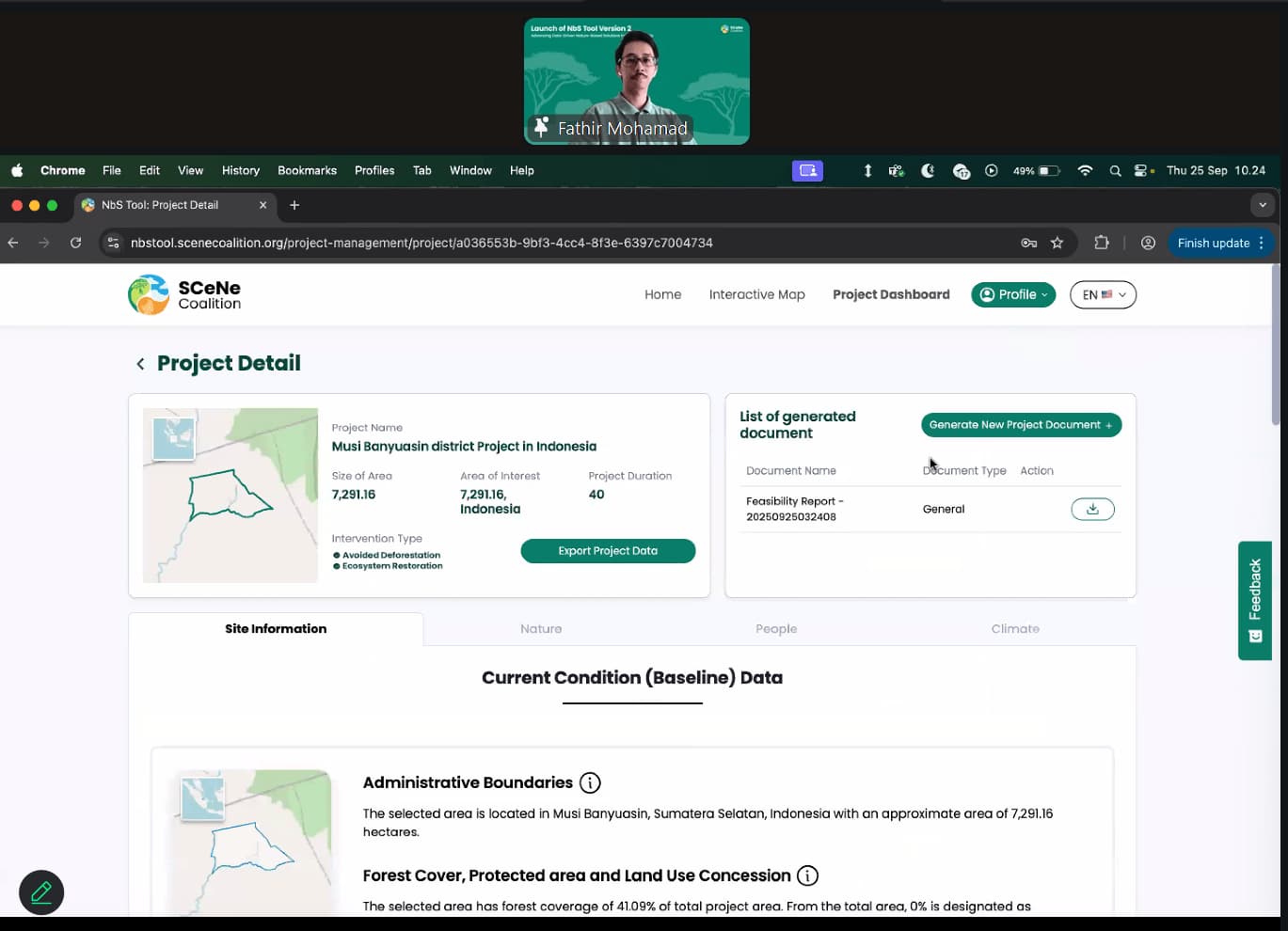
The following day, the series continued with a Live Demo and User Feedback Session led by Fathir Mohamad and Muhammad Rafli Fadilah from WRI Indonesia. The session guided participants through all features of the tool, demonstrating its functionality in real time, followed by an open question and answer segment where users shared experiences and suggestions. This interactive format allowed practitioners to explore how the tool could be tailored to their specific contexts and helped the development team gather valuable input for future updates.
Fathir Mohammad delivering NbS Tool feature walkthrough
Dewi Sari also shared how the NbS Tool has been implemented at the ground level and highlighted success stories from its users. “Now the NbS Tool is mainly being implemented by frontline organizations. We wanted the tool to be used by them to develop projects, but now it is used more broadly. For example, some use it just to generate maps because they don’t have the capacity for GIS, or to write impact reports, or to prepare documents to submit to the government for social forestry programs,” she explained. These examples show how the tool has evolved beyond its initial function and become a versatile resource for a variety of practical needs.
However, she also noted that challenges remain. “Obtaining data is the biggest challenge, especially because we want to make sure it is publicly available. If you see the data, there’s a lot of it, but we want to choose data that gives meaningful insights for NbS potential,” she said. “The data from different sources are often not aligned, and that’s something we are currently addressing.” Ensuring that the data is both accessible and reliable continues to be a major focus of the team’s ongoing work.
Version 2 of the NbS Tool stands as a reflection of collaboration and continuous learning. Every new layer and feature represents the voices of practitioners, researchers, and community members who use it to drive meaningful action. More than just a technological upgrade, it embodies a shared commitment to advancing transparency, credibility, and impact in nature-based solutions.
As more organizations in Southeast Asia adopt and adapt this platform, the hope is that it will continue to bridge the gap between science and practice, and between ambition and action. Through data, collaboration, and innovation, the NbS Tool helps unlock what nature has always had to offer: solutions that work in harmony with people and the planet.